About MF
Breaking down myelofibrosis: myelo = bone marrow | fibrosis = scarring
If MF is a person’s first myeloproliferative neoplasm (MPN), then it is called primary MF. In other cases, MF can develop from other diseases, like polycythemia vera (PV) or essential thrombocythemia (ET). These conditions are called post–PV MF and post–ET MF.
MF is a chronic disease that may get worse over time, but it can be managed with treatment. You may not always notice the impact of MF right away because changes can happen gradually. The sooner you start treatment for your MF symptoms, the better your long-term outcomes may be.
Specific scoring tools may be used to determine if your MF is considered to be low-, intermediate-, or high-risk. How your MF is classified may affect how your condition is managed.
Scoring systems may include:
The International Prognostic Scoring System (IPSS)
- Uses 5 specific risk factors to predict survival
- Is used to estimate prognosis at the time of diagnosis
The Dynamic International Prognostic Scoring System (DIPSS)
- Uses the same 5 specific risk factors as IPSS
- Is used to estimate prognosis at any time during your MF journey
The DIPSS Plus
- Uses the same 5 DIPSS risk factors, plus 3 additional risk factors
- Builds upon DIPSS by using additional risk factors
It’s important to understand how MF can affect your body over time. In its very early stages, the disease may be silent. You might not experience symptoms even though the disease may be progressing. As the disease gets worse, you may start to experience more signs and symptoms.
There are many risk factors that can affect the course—or progression—of your MF. Recognizing signs and symptoms of MF can help you share your concerns with your doctor so that you can take an active role in managing your MF.

Your spleen is a small organ near your stomach that is located under your left rib cage. The spleen helps your body by:
- Filtering your blood
- Storing blood cells
- Fighting infection
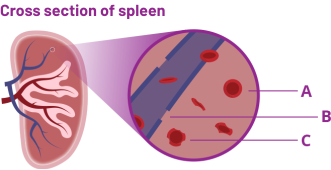
How the spleen helps the body filter the blood:
- Healthy red blood cells (A) pass back into the body through small openings in veins (B)
- Old or damaged cells (C) get caught and are broken down
Your spleen is usually about the size of your fist. But in people with MF, it can get bigger.
With MF, scar tissue builds up within the bone marrow, preventing it from making enough normal blood cells. As a result, the spleen partially takes over blood cell production, causing the spleen to get bigger, or become enlarged. This condition is called splenomegaly.
For some people with MF, a bigger spleen can be a sign that the disease is getting worse. That’s why it’s important to have your spleen checked regularly as part of your MF care.
Recognizing the signs and symptoms of an enlarged spleen can help you take a more active role in your MF. Know which questions you should be asking yourself before your next office visit and share your concerns with your doctor.
Since your spleen is located in your abdominal area, a swollen or enlarged spleen can cause various symptoms, including:
- Discomfort in your stomach
- Pain under your left ribs
- Feeling full too soon when eating—even if you’ve only had a small amount of food
It’s important to work with your doctor to find out your spleen size early—usually when you’re first diagnosed with MF. This is called your ’baseline’ spleen size.
Your doctor may check your spleen during a physical exam by gently pressing on the upper left side of your belly to feel if it’s larger than normal.
Sometimes, it can be hard to accurately measure spleen size through a physical exam alone. Your doctor may order a scan or imaging test to get a clearer picture. These tests may include:

Ultrasound

Computed tomography,also called a CT scan

Magnetic resonance imaging (MRI)
Early identification of an enlarged spleen is important and may help your doctor see if your MF is progressing or how well your treatment is working. Remember, it’s important to work closely with your doctor to regularly keep track of your symptoms and any changes in your spleen size.
About JAKAFI® and JAKAFI XR™ (ruxolitinib)
You won’t be able to pick up JAKAFI or JAKAFI XR at a local pharmacy. JAKAFI or JAKAFI XR will be sent to you from a specialty pharmacy.
To help you avoid possible interactions between drugs, it’s important that you tell your local pharmacist that you’re taking JAKAFI or JAKAFI XR. It’s also important to tell the specialty pharmacy about any other medicines, vitamins, and supplements that you’re taking.
For more information about getting your JAKAFI or JAKAFI XR prescription filled, contact IncyteCARES for JAKAFI at 1-855-452-5234, Monday through Friday, 8 AM–8 PM ET, or visit IncyteCARES.com/JAKAFI.
JAKAFI or JAKAFI XR may lower your red blood cell, white blood cell, and platelet counts. Your doctor will do blood tests to monitor your blood counts regularly while you’re taking JAKAFI or JAKAFI XR. Your doctor may lower your dose of JAKAFI or JAKAFI XR, temporarily stop JAKAFI or JAKAFI XR, or give blood transfusions based on the results of your blood tests.
JAKAFI or JAKAFI XR can cause anemia (low red blood cell counts). When you start taking JAKAFI or JAKAFI XR, you should watch for the symptoms of anemia and discuss them with your doctor. They include:
- Fatigue (extreme tiredness) or a lack of energy
- Shortness of breath (especially during exercise)
If you develop anemia, your doctor will determine the best way to treat it. Your doctor will also check your blood counts and adjust your dose of JAKAFI or JAKAFI XR accordingly.
Yes. JAKAFI was studied in people with MF, including people who had anemia (low red blood cell counts).
Anemia is a possible side effect of JAKAFI. Your doctor will check your blood counts before and during treatment and may change your dose if needed.
Please see the full Prescribing Information for JAKAFI for additional information on dosing, warnings and precautions, and adverse reactions.
JAKAFI was compared to placebo (a sugar pill) in 309 people living with intermediate- or high-risk MF. The people who entered the study had an enlarged spleen due to MF. The main goal of the study was to see how many people had a reduction in spleen size of at least 35%.
The results of the study showed that 42% of people (65 out of 155) who received JAKAFI had at least a 35% reduction in their spleen size compared with 1% of people (1 out of 154) who received a placebo.
JAKAFI or JAKAFI XR can cause serious side effects, including:
Low blood counts: JAKAFI or JAKAFI XR may cause low platelet, red blood cell, and white blood cell counts. If you develop bleeding, stop taking JAKAFI or JAKAFI XR and call your doctor. Your doctor will do a blood test to check your blood counts before you start and regularly during your treatment. Your doctor may change your dose or stop your treatment based on the results of your blood tests. Tell your doctor right away if you develop or have worsening symptoms such as
- unusual bleeding
- bruising
- tiredness
- shortness of breath
- fever
Infection: You may be at risk for developing a serious infection during treatment with JAKAFI or JAKAFI XR. Tell your doctor if you develop any of the following symptoms of infection:
- chills
- nausea
- vomiting
- aches
- weakness
- fever
- painful skin rash or blisters
Worsening of symptoms after interrupting or stopping treatment. Signs and symptoms of myelofibrosis may worsen after you stop treatment.Do not interrupt or stop treatment without talking to your doctor. Tell your doctor right away if you have any of the following after stopping treatment:
- fever
- trouble breathing
- weakness
- night sweats
- feeling dizzy or lightheaded
- pain in left upper stomach area or left shoulder
Cancer: Some people have had certain types of non-melanoma skin cancers during treatment with JAKAFI or JAKAFI XR. Your doctor will regularly check your skin during your treatment. Tell your doctor if you develop any new or changing skin lesions during treatment.
Increases in cholesterol: You may have changes in your blood cholesterol levels during treatment with JAKAFI or JAKAFI XR. Your doctor will do blood tests to check your cholesterol levels about every 8 to 12 weeks after you start taking JAKAFI or JAKAFI XR and as needed.
Increased risk of major cardiovascular events such as heart attack, stroke or death in people who have cardiovascular risk factors and who are current or past smokers while using another JAK inhibitor to treat rheumatoid arthritis:
Get emergency help right away if you get any symptoms of a heart attack or stroke during treatment with JAKAFI or JAKAFI XR, including:
- discomfort in the center of your chest that lasts for more than a few minutes, or that goes away and comes back
- severe tightness, pain, pressure, or heaviness in your chest, throat, neck, or jaw
- pain or discomfort in your arms, back, neck, jaw, or stomach
- shortness of breath with or without chest discomfort
- breaking out in a cold sweat
- nausea or vomiting
- feeling lightheaded
- weakness in one part or on one side of your body
- slurred speech
Increased risk of blood clots: Blood clots in the veins of your legs (deep vein thrombosis, DVT) or lungs (pulmonary embolism, PE) have happened in people taking another JAK inhibitor for rheumatoid arthritis and may be life-threatening.
Tell your doctor right away if you have any signs and symptoms of blood clots during treatment with JAKAFI or JAKAFI XR, including:
- swelling, pain, or tenderness in one or both legs
- sudden, unexplained chest or upper back pain
- shortness of breath or difficulty breathing
Possible increased risk of new (secondary) cancers: People who take another JAK inhibitor for rheumatoid arthritis have an increased risk of new (secondary) cancers, including lymphoma and other cancers. People who smoke or who smoked in the past have an added risk of new cancers.
The most common side effects of JAKAFI or JAKAFI XR in adults with MF include:
- low platelet counts
- low red blood cell counts
- bruising
- dizziness
- headache
- diarrhea
These are not all the possible side effects of JAKAFI or JAKAFI XR. Call your doctor for medical advice about side effects. You may report side effects to FDA at 1-800-FDA-1088. You may also report side effects to Incyte Corporation at 1-855-463-3463.
Before taking JAKAFI or JAKAFI XR, tell your doctor about all of your medical conditions, including if you:
- have or have had low white or red blood cell counts
- have an infection
- have or had tuberculosis (TB), or have been in close contact with someone who has TB
- have had shingles (herpes zoster)
- have or had hepatitis B
- have a high level of fat in your blood (high blood cholesterol or triglycerides)
- have had a blood clot, heart attack, other heart problems, or stroke
- are a current or past smoker
- have had cancer in the past
- have or have had kidney problems or are on dialysis. If you are on dialysis, JAKAFI or JAKAFI XR should be taken after your dialysis
- have or have had liver problems
- are pregnant or plan to become pregnant. It is not known if JAKAFI or JAKAFI XR will harm your unborn baby
- are breastfeeding or plan to breastfeed. It is not known if JAKAFI or JAKAFI XR passes into your breast milk. Do not breastfeed during treatment with JAKAFI or JAKAFI XR and for 2 weeks after the final dose
Tell your doctor about all the medicines you take, including prescription and over-the-counter medicines, vitamins, and herbal supplements. Taking JAKAFI or JAKAFI XR with certain other medicines may affect how JAKAFI or JAKAFI XR works. Know the medicines you take. Keep a list of them to show your doctor and pharmacist when you get a new medicine.
Download the MF Healthcare Appointment Workbook
Everyone responds to JAKAFI or JAKAFI XR differently, so it may take time to see results. Your doctor will regularly do blood tests to monitor your blood counts and check your spleen size during your treatment with JAKAFI or JAKAFI XR. Based on how your body responds to treatment, your doctor may adjust your dose of JAKAFI or JAKAFI XR. It is important to tell your doctor about how you’re feeling and how your MF is affecting you.
If you’ve been diagnosed with MF, have intermediate- or high-risk myelofibrosis, talk to your doctor about switching to a treatment that may help you feel more like yourself.
Tell your doctor about any concerns that you may have and ask if JAKAFI or JAKAFI XR may be a treatment option for you.
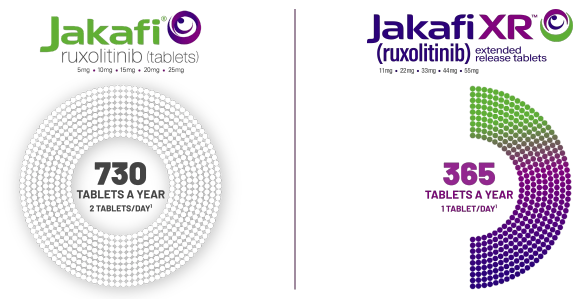
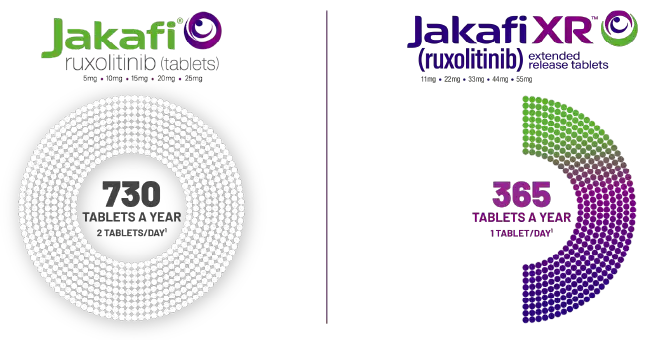
JAKAFI XR has the same active ingredient as JAKAFI. JAKAFI XR is an extended-release tablet that is taken once a day, at the same time each day.
JAKAFI is an immediate-release tablet that is taken twice a day by mouth. Because everyone is different, and because your dosage may change during treatment, JAKAFI and JAKAFI XR are available in different dosage strengths. You should take the dosage prescribed to you by your doctor.
JAKAFI Dosages
JAKAFI XR Dosages
5 mg twice daily
11 mg once daily
10 mg twice daily
22 mg once daily
15 mg twice daily
33 mg once daily
20 mg twice daily
44 mg once daily
25 mg twice daily
55 mg once daily
MF is a chronic disease that may get worse over time. It doesn't go away, but it can be managed with the right treatment. That's why it's important to stay on treatment to help keep the disease under control and to slow down its progression.
If your doctor decides that JAKAFI or JAKAFI XR is right for you, it’s important that you continue to take JAKAFI or JAKAFI XR as prescribed. JAKAFI and JAKAFI XR are long-term treatments.
It’s important to take JAKAFI or JAKAFI XR exactly as directed by your doctor. Do not stop taking JAKAFI or JAKAFI XR without speaking with your doctor. The only exception is that if you start bleeding, stop taking JAKAFI or JAKAFI XR and call your doctor right away.
Store JAKAFI and JAKAFI XR at room temperature 68 °F to 77 °F (20 °C to 25 °C).
Keep JAKAFI and JAKAFI XR and all medicines out of the reach of children.
JAKAFI or JAKAFI XR can be taken with or without food.
If you miss a dose of JAKAFI or JAKAFI XR, take your next dose at your regular time. Do not take 2 doses at the same time.
If you take too much JAKAFI or JAKAFI XR, call your doctor or go to the nearest hospital emergency room right away.
Take the bottle of JAKAFI or JAKAFI XR with you.
Access and support for JAKAFI and JAKAFI XR
Getting a new prescription or insurance plan can be confusing, especially when you're trying to figure out what's covered. Ask your doctor about enrolling you in IncyteCARES and see how IncyteCARES can help eligible people with insurance assistance. Our team is available to walk you through this process.
IncyteCARES is a support program that helps eligible patients get started with JAKAFI or JAKAFI XR and stay on track during treatment. It offers helpful information, insurance and access support, and ongoing guidance.
Talk to your doctor about IncyteCARES to see how it might support you.
If you're eligible, the IncyteCARES Savings Program may help lower your out-of-pocket costs. There's also a Patient Assistance Program (PAP) that may provide JAKAFI or JAKAFI XR at no cost for people who qualify.
Talk to your doctor or visit IncyteCARES.com to learn more.